India Retail & E-Commerce — sector deep-dive
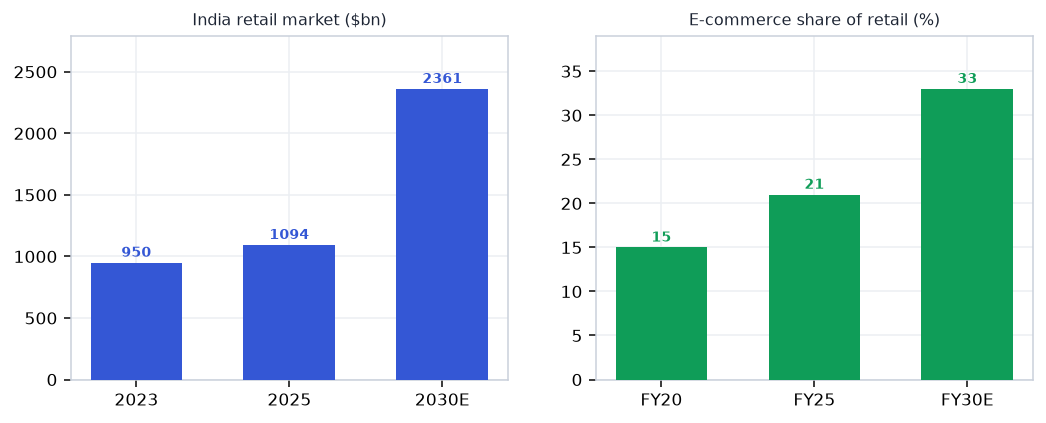
India retail is a $1.09 trillion market compounding toward ~$2.4 trillion by 2030, and the entire investment story…
01Executive summary
India retail is a $1.09 trillion market compounding toward ~$2.4 trillion by 2030, and the entire investment story is share shift: organised trade taking the kirana economy's share on GST compliance and assortment, e-commerce moving from 21% toward a third of all retail, hallmarking formalising a ₹5-6 lakh crore jewellery market, and quick commerce building a 4,500-dark-store urban logistics layer that just produced its first profitable quarter (Blinkit, ₹37 cr). FY26 delivered across formats — DMart SSSG 10.8%, Titan +33%, Kalyan +43%, Nykaa EBITDA +59% — and Budget FY27's ₹12-lakh tax exemption hands the core organised-retail cohort a durable spending boost. The discipline problem is price: the great franchises trade at 68-88x, while the market's actual cash machines (classifieds, distribution) sit at 9-25x. Gold's May-2026 duty hike and quick-commerce burn are the two live tensions.
Why now
- Retail sales growth re-accelerated to +8% YoY in June 2026 (RAI) — the best print in four quarters — with the first festive season on the ₹12-lakh tax-cut cohort still ahead.
- Quick commerce just crossed its existential threshold: Blinkit's first EBITDA-positive quarter proves the dark-store model monetises at density — the land-grab now has a business model behind it.
- Jewellery formalisation got a valuation gift: May's import-duty hike knocked ~20% off leading jewellers while the structural share-shift (hallmarking, GST, franchise scale) is untouched.
Key risks
- Quick-commerce order-density dilution: all three players plan ~1,500 new dark stores in FY27 (Zepto's IPO funds the war) — expansion can un-do the unit economics just proven.
- Gold at ₹1.62L/10g plus a 15% import duty suppresses jewellery volumes even as value grows — Q1 FY27 volume prints are the test.
- DMart's flagged Q1 FY27 deceleration is the canary for urban mass consumption — staples multiples at 88x have no cushion for a slowdown.
02The demand engine
Where the demand comes from — the structural drivers pulling the sector's order books.
Unlock the full Retail & E-Commerce report
8 more sections — the graded universe, scenario analysis, institutional flows and the downloadable fund-grade PDF.
₹399/month · every sector report + Orion queries · cancel anytime · Already a member? Sign in
Frequently asked questions
How big is India's Retail & E-Commerce opportunity in 2026?
India retail is a $1.09 trillion market compounding toward ~$2.4 trillion by 2030, and the entire investment story… The key numbers that frame the sector: $1.09tn → $2.4tn (India retail 2025 → 2030E); 21% → 33% (e-commerce share of retail, FY25 → FY30E); ₹37 cr (Blinkit Q4 FY26 EBITDA — QC's first profitable quarter); +43% (Kalyan FY26 revenue — jewellery formalisation × gold price); ₹12 lakh (Budget FY27 tax exemption — the discretionary unlock). On the demand side, Quick-commerce orders stands at 274mn/qtr — Blinkit Q4 alone; 4,525 dark stores top-3. Together these define both the size of the Retail & E-Commerce profit pool and the pace at which it is compounding — the full report maps where along the value chain that value actually lands.
What is driving growth in India's Retail & E-Commerce sector?
Retail sales growth re-accelerated to +8% YoY in June 2026 (RAI) — the best print in four quarters — with the first festive season on the ₹12-lakh tax-cut cohort still ahead. Quick commerce just crossed its existential threshold: Blinkit's first EBITDA-positive quarter proves the dark-store model monetises at density — the land-grab now has a business model behind it. Jewellery formalisation got a valuation gift: May's import-duty hike knocked ~20% off leading jewellers while the structural share-shift (hallmarking, GST, franchise scale) is untouched. Each of these drivers is tracked in the report's catalyst section with dated windows, so readers can verify whether the thesis is playing out on schedule.
What are the key risks in the India Retail & E-Commerce sector?
Quick-commerce order-density dilution: all three players plan ~1,500 new dark stores in FY27 (Zepto's IPO funds the war) — expansion can un-do the unit economics just proven. Gold at ₹1.62L/10g plus a 15% import duty suppresses jewellery volumes even as value grows — Q1 FY27 volume prints are the test. DMart's flagged Q1 FY27 deceleration is the canary for urban mass consumption — staples multiples at 88x have no cushion for a slowdown. The full report carries an eight-item risk register scored on likelihood and severity, plus a bear-case scenario that quantifies how these risks would transmit through each node of the value chain.
Which companies are covered in India's Retail & E-Commerce sector report?
The report covers 26 listed companies across the full value chain (Brands & private label → Distribution → Physical formats → Digital → Demand), so upstream suppliers, manufacturers and downstream distribution are all graded on the same yardstick. Names screening strongest on this objective test currently include V-Mart Retail, Shoppers Stop, Landmark Cars, Nykaa (FSN), Arvind Fashions. Every company named in the report links to its live VestAI stock page, and the universe table lets readers sort the full list on valuation, returns and balance-sheet quality.
How does VestAI grade Retail & E-Commerce companies?
Every name in the universe is graded on cash conversion — cumulative 3-year operating cash flow measured against reported profit. This is a data classification, not an opinion: the grade asks whether reported profits actually arrive as cash, which is where accounting-quality problems show up first. The same forensic yardstick is applied across all 30 VestAI sector reports, so a grade in Retail & E-Commerce is directly comparable to a grade in any other sector — and grades refresh with each quarterly data update.
Where can I read VestAI's full Retail & E-Commerce sector analysis?
The free version of this page includes the executive summary, key sector numbers, demand drivers, key risks and this FAQ — enough to understand how the Retail & E-Commerce value chain earns its money. VestAI Pro and Max members unlock the full report: the complete value-chain map with node economics, dated recent developments, the catalyst tracker, competitive structure, the scenario matrix with per-node impacts, the graded 26-company universe with an interactive comparison table, and a downloadable 15-page PDF edition. Reports are rebuilt each quarter on fresh filings, and all content is educational research rather than investment advice.
India's ₹25.7L cr power + transmission super-cycle through 2030 is structural — underwritten by peak-demand…
India's defence budget has crossed ₹6.81L cr in FY26 (FY27 BE ₹7.85L cr, +16%) with ₹1.86L cr capital outlay…
India ESDM market ₹3.1L cr (~$37bn) is tracking toward ₹7-8L cr by 2030, underpinned by a ₹1.91L cr PLI outlay…