🔌 Industry Report · EMS / Semicon

India EMS / Semicon — sector deep-dive

India ESDM market ₹3.1L cr (~$37bn) is tracking toward ₹7-8L cr by 2030, underpinned by a ₹1.91L cr PLI outlay…

VVestAI ResearchUpdated 2026-07-0613 min read23 companies
TL;DR — India ESDM market ₹3.1L cr (~$37bn) is tracking toward ₹7-8L cr by 2030, underpinned by a ₹1.91L cr PLI outlay… Key figures: ₹3.1L cr ESDM market FY26 (~$37bn) → ₹7-8L cr 2030 and ~$155bn India electronics production FY26 vs $300bn target. This report screens every listed EMS / Semicon name on cash conversion, balance-sheet quality and valuation.
₹3.1L cr
ESDM market FY26 (~$37bn) → ₹7-8L cr 2030
~$155bn
India electronics production FY26 vs $300bn target
₹1.91L cr
PLI outlay — 14 sectors + ₹22,919 cr components PLI
₹76,000 cr
Semiconductor Mission (10 fab/OSAT projects)
~25%
Apple India share of global iPhone production (2026)

01Executive summary

India ESDM market ₹3.1L cr (~$37bn) is tracking toward ₹7-8L cr by 2030, underpinned by a ₹1.91L cr PLI outlay across 14 sectors and a ₹76,000 cr Semiconductor Mission that has already pulled in Micron's Sanand ATMP (live Feb 2026), the Tata-PSMC Dholera 300mm fab (construction 50% done), and CG-Renesas OSAT. Electronics production is ~$155bn in FY26 against the $300bn 2030 target, with Apple India now at ~25% of global iPhone production and mobile exports crossing $30bn. But the listed EMS universe earns only 3-7% EBITDA — box-build is structurally thin. Durable profit compounds in design-led EMS, ODM, defence/aerospace EMS, and chip-design (12-23% EBITDA). Dixon is the sector's best-run large EMS (ROCE 23%, 1.38x cash, cheapest at ~46x) and D-Link is the overlooked cash-rich optionality play.

Why now

  • Micron Sanand ATMP commercially live (Feb 2026) and Tata Dholera 50% built — India's semiconductor mission is no longer a promise; the ISM flywheel is rotating.
  • Apple India locked in at ~25% global iPhone production with $50bn+ exports — supply-chain deepening is durable regardless of US-China tariff outcome.
  • Dixon re-rated lower post Q4 miss (−5.9%) creating a better entry for the sector's strongest cash compounder as ODM mix shift toward 25-30% revenue accelerates.

Key risks

  • Apple rerouting risk — US-China tariff détente or India-US deal collapse could slow the 25% global share accumulation; PLI mobile lapse in FY27 compresses Dixon economics.
  • Tata Dholera execution — soil-redesign delays push trial silicon beyond H2 CY2026; PSMC/TSMC tech-transfer pace and ₹91,000 cr capex absorption remain uncertain.
  • Valuation de-rate in high-PE EMS pack — Kaynes 59x, Netweb 124x, Avalon 104x richly valued; any earnings miss or working-capital deterioration = sharp correction.

02The demand engine

Where the demand comes from — the structural drivers pulling the sector's order books.
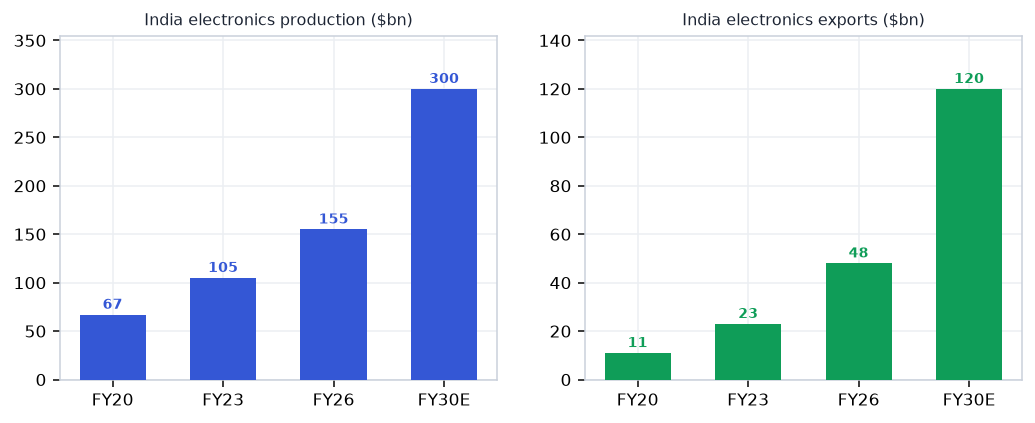
EMS / Semicon demand drivers chart
Demand drivers. Source: government plans, company filings, industry estimates.
🔒

Unlock the full EMS / Semicon report

8 more sections — the graded universe, scenario analysis, institutional flows and the downloadable fund-grade PDF.

Value chain & profit-pool economics
Catalyst & policy timeline
Institutional flow trends & top movers
Bull / base / bear scenarios
Every listed name, forensically graded
Downloadable fund-grade PDF

₹399/month · every sector report + Orion queries · cancel anytime · Already a member? Sign in

Frequently asked questions

How big is India's EMS / Semicon opportunity in 2026?

India ESDM market ₹3.1L cr (~$37bn) is tracking toward ₹7-8L cr by 2030, underpinned by a ₹1.91L cr PLI outlay… The key numbers that frame the sector: ₹3.1L cr (ESDM market FY26 (~$37bn) → ₹7-8L cr 2030); ~$155bn (India electronics production FY26 vs $300bn target); ₹1.91L cr (PLI outlay — 14 sectors + ₹22,919 cr components PLI); ₹76,000 cr (Semiconductor Mission (10 fab/OSAT projects)); ~25% (Apple India share of global iPhone production (2026)). Together these define both the size of the EMS / Semicon profit pool and the pace at which it is compounding — the full report maps where along the value chain that value actually lands.

What is driving growth in India's EMS / Semicon sector?

Micron Sanand ATMP commercially live (Feb 2026) and Tata Dholera 50% built — India's semiconductor mission is no longer a promise; the ISM flywheel is rotating. Apple India locked in at ~25% global iPhone production with $50bn+ exports — supply-chain deepening is durable regardless of US-China tariff outcome. Dixon re-rated lower post Q4 miss (−5.9%) creating a better entry for the sector's strongest cash compounder as ODM mix shift toward 25-30% revenue accelerates. Each of these drivers is tracked in the report's catalyst section with dated windows, so readers can verify whether the thesis is playing out on schedule.

What are the key risks in the India EMS / Semicon sector?

Apple rerouting risk — US-China tariff détente or India-US deal collapse could slow the 25% global share accumulation; PLI mobile lapse in FY27 compresses Dixon economics. Tata Dholera execution — soil-redesign delays push trial silicon beyond H2 CY2026; PSMC/TSMC tech-transfer pace and ₹91,000 cr capex absorption remain uncertain. Valuation de-rate in high-PE EMS pack — Kaynes 59x, Netweb 124x, Avalon 104x richly valued; any earnings miss or working-capital deterioration = sharp correction. The full report carries an eight-item risk register scored on likelihood and severity, plus a bear-case scenario that quantifies how these risks would transmit through each node of the value chain.

Which companies are covered in India's EMS / Semicon sector report?

The report covers 23 listed companies across the full value chain (Materials & wafers → Components → Assembly / EMS → ODM / Design & OSAT / Fab → End-demand), so upstream suppliers, manufacturers and downstream distribution are all graded on the same yardstick. Names screening strongest on this objective test currently include DCX Systems, EPACK Durable, MosChip Technologies, Amber Enterprises, Centum Electronics. Every company named in the report links to its live VestAI stock page, and the universe table lets readers sort the full list on valuation, returns and balance-sheet quality.

How does VestAI grade EMS / Semicon companies?

Every name in the universe is graded on cash conversion — cumulative 3-year operating cash flow measured against reported profit. This is a data classification, not an opinion: the grade asks whether reported profits actually arrive as cash, which is where accounting-quality problems show up first. The same forensic yardstick is applied across all 30 VestAI sector reports, so a grade in EMS / Semicon is directly comparable to a grade in any other sector — and grades refresh with each quarterly data update.

Where can I read VestAI's full EMS / Semicon sector analysis?

The free version of this page includes the executive summary, key sector numbers, demand drivers, key risks and this FAQ — enough to understand how the EMS / Semicon value chain earns its money. VestAI Pro and Max members unlock the full report: the complete value-chain map with node economics, dated recent developments, the catalyst tracker, competitive structure, the scenario matrix with per-node impacts, the graded 23-company universe with an interactive comparison table, and a downloadable 15-page PDF edition. Reports are rebuilt each quarter on fresh filings, and all content is educational research rather than investment advice.

VestAI · Orion Industry Research · Educational research — not investment advice
    India EMS / Semicon Sector Analysis 2026 — Demand, Value Chain & Outlook | VestAI