India Railways — sector deep-dive
Indian Railways' ₹2.65 lakh-cr FY27 capex budget — the largest ever — is being deployed across three…
01Executive summary
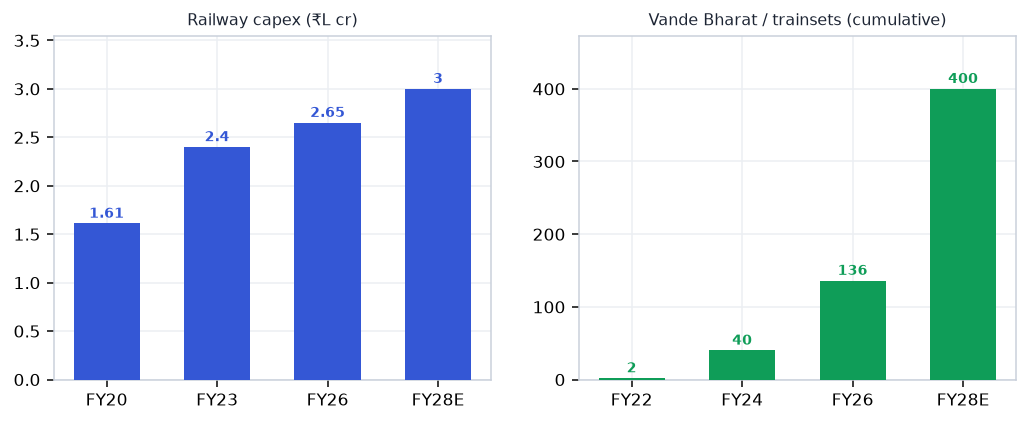
Indian Railways' ₹2.65 lakh-cr FY27 capex budget — the largest ever — is being deployed across three high-conviction structural pillars: the Vande Bharat mass-fleet (400+ sets ordered, 1,200+ target by FY30), the 3,300 km Dedicated Freight Corridor now fully operational (EDFC + WDFC) driving a private-freight revolution, and the Kavach TCAS safety mandate (3,000 km/yr rollout, ₹1L cr addressable, near-zero competition). Profit concentrates in tight oligopolies — HBL Engineering owns 80%+ of Kavach hardware revenue, CONCOR controls 65% of rail-container logistics with direct DFC tailwind, Ramkrishna Forgings supplies >30% of domestic railway wheel/axle demand with no credible new entrant, and RITES holds a statutory consulting monopoly with 3%+ dividend cover. Tender-deferral headwinds that plagued FY25 have cleared; FY26 execution has resumed at pace and the FY27 budget leaves no ambiguity on government commitment.
Why now
- ₹2.65L cr IR FY27 capex is budgeted and tendering is live — no binary budget-approval risk; HBL Engineering's ₹4.5k cr Kavach book already locks in 24+ months of revenue.
- DFC 3,300 km is fully operational — CONCOR's volume-growth acceleration from a proven infrastructure base is a tangible, trackable catalyst (not a promise).
- FY25 tender-deferral hangover has cleared; FY26 execution pace recovered and Ramkrishna Forgings' Q4 CFO/PAT 1.1x confirms the earnings quality is intact.
Key risks
- Kavach loco-fitment supply chain (antenna/processor components) could bottleneck rollout to 1,500 km/yr instead of 3,000 — HBL revenue and order-conversion at risk.
- DFC private-freight ramp slower than expected if road-transport incumbents sustain aggressive pricing — CONCOR volume guidance of 15-18% could disappoint to 8-10%
- Wagon OEM cycle (Jupiter Wagons, Titagarh) still digesting FY26 lumpy orders; any fresh IR procurement delay triggers sharp earnings-miss risk for satellite names.
02The demand engine
Where the demand comes from — the structural drivers pulling the sector's order books.
Unlock the full Railways report
8 more sections — the graded universe, scenario analysis, institutional flows and the downloadable fund-grade PDF.
₹399/month · every sector report + Orion queries · cancel anytime · Already a member? Sign in
Frequently asked questions
How big is India's Railways opportunity?
Indian Railways' ₹2.65 lakh-cr FY27 capex budget — the largest ever — is being deployed across three… Key figures include ₹2.65L cr IR capex budget FY27 — largest ever and 400+ sets Vande Bharat ordered; 1,200+ target by FY30.
What is driving growth in India's Railways sector?
₹2.65L cr IR FY27 capex is budgeted and tendering is live — no binary budget-approval risk; HBL Engineering's ₹4.5k cr Kavach book already locks in 24+ months of revenue.
What are the key risks in the India Railways sector?
Kavach loco-fitment supply chain (antenna/processor components) could bottleneck rollout to 1,500 km/yr instead of 3,000 — HBL revenue and order-conversion at risk. DFC private-freight ramp slower than expected if road-transport incumbents sustain aggressive pricing — CONCOR volume guidance of 15-18% could disappoint to 8-10%
Where can I read VestAI's full analysis of the Railways sector?
VestAI's full Railways report covers every listed name with forensic screening, quality grades and scenario analysis — available to VestAI Pro and Max members.
India's ₹25.7L cr power + transmission super-cycle through 2030 is structural — underwritten by peak-demand…
India's defence budget has crossed ₹6.81L cr in FY26 (FY27 BE ₹7.85L cr, +16%) with ₹1.86L cr capital outlay…
India ESDM market ₹3.1L cr (~$37bn) is tracking toward ₹7-8L cr by 2030, underpinned by a ₹1.91L cr PLI outlay…