India Consumption / FMCG — sector deep-dive
India's ₹220bn FMCG market is bifurcating: the top 15% of earners are driving premiumisation (Zudio, Kalyan, Royal…
01Executive summary
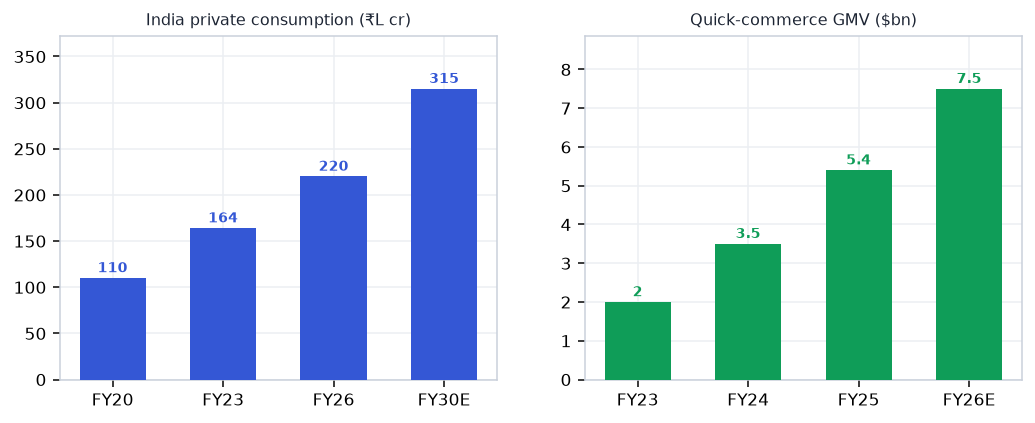
India's ₹220bn FMCG market is bifurcating: the top 15% of earners are driving premiumisation (Zudio, Kalyan, Royal Enfield, premium spirits) at 18-25% volume growth while mass-market FMCG faces a structural squeeze from quick-commerce (Blinkit, Zepto, Swiggy Instamart GMV $10bn+) disrupting traditional GT distribution. Urban FMCG growth of 12% vs rural 8% reflects a K-shaped recovery where the weddings- driven discretionary cycle (gold, jewellery, apparel) remains remarkably resilient. Rate cuts provide an additional tailwind to white goods and auto.
Why now
- Premiumisation secular theme is intact and accelerating: Radico FY26 EBITDA +52%, Trent 600+ Zudio stores, Kalyan GCC franchise — all reporting record prints with no visible slowdown; the K-shape is a feature, not a bug, for premium-oriented picks.
- Rate-cut cycle underway (RBI cut 50bps in H1 CY2026) unlocks EMI-led durable goods and housing-linked categories (Pidilite Fevicol) — construction pick-up visible in channel checks across Maharashtra, Gujarat, and NCR.
- Wedding-season Dhanteras + Diwali Oct-Dec 2026 is the strongest discrete catalyst for gold jewellery (Kalyan) and premium spirits (Radico) — advance bookings signal record festive season ahead of the Q3 FY27 print.
Key risks
- Quick-commerce GMV disruption accelerates faster than expected — Blinkit/Zepto reach 15%+ urban FMCG share by FY28 eroding GT revenues of mass-FMCG incumbents (HUL, Nestle, Britannia) and pressuring distribution-margin assumptions.
- Rural recovery stalls if monsoon is below-normal or kharif MSP hikes disappoint — Rural FMCG still 40%+ of volumes for most incumbents; a second consecutive weak rural season could trigger earnings cuts across the sector.
- Premium discretionary valuations (Trent 95x, Kalyan 55x) leave zero room for error — any LFL deceleration, store roll-out miss, or gross-margin compression triggers sharp 20-30% de-ratings; position sizing discipline is non-negotiable.
02The demand engine
Where the demand comes from — the structural drivers pulling the sector's order books.
Unlock the full Consumption / FMCG report
8 more sections — the graded universe, scenario analysis, institutional flows and the downloadable fund-grade PDF.
₹399/month · every sector report + Orion queries · cancel anytime · Already a member? Sign in
Frequently asked questions
How big is India's Consumption / FMCG opportunity?
India's ₹220bn FMCG market is bifurcating: the top 15% of earners are driving premiumisation (Zudio, Kalyan, Royal… Key figures include $220bn India FMCG market size (FY26) and $10bn+ Quick-commerce annualised GMV (Blinkit + Zepto + Instamart).
What is driving growth in India's Consumption / FMCG sector?
Premiumisation secular theme is intact and accelerating: Radico FY26 EBITDA +52%, Trent 600+ Zudio stores, Kalyan GCC franchise — all reporting record prints with no visible slowdown; the K-shape is a feature, not a bug, for premium-oriented picks.
What are the key risks in the India Consumption / FMCG sector?
Quick-commerce GMV disruption accelerates faster than expected — Blinkit/Zepto reach 15%+ urban FMCG share by FY28 eroding GT revenues of mass-FMCG incumbents (HUL, Nestle, Britannia) and pressuring distribution-margin assumptions. Rural recovery stalls if monsoon is below-normal or kharif MSP hikes disappoint — Rural FMCG still 40%+ of volumes for most incumbents; a second consecutive weak rural season could trigger earnings cuts across the sector.
Where can I read VestAI's full analysis of the Consumption / FMCG sector?
VestAI's full Consumption / FMCG report covers every listed name with forensic screening, quality grades and scenario analysis — available to VestAI Pro and Max members.
India's ₹25.7L cr power + transmission super-cycle through 2030 is structural — underwritten by peak-demand…
India's defence budget has crossed ₹6.81L cr in FY26 (FY27 BE ₹7.85L cr, +16%) with ₹1.86L cr capital outlay…
India ESDM market ₹3.1L cr (~$37bn) is tracking toward ₹7-8L cr by 2030, underpinned by a ₹1.91L cr PLI outlay…